Paper “Multi-Task Optimization over Networks of Tasks” published on arXiv
Paper “Multi-Task Optimization over Networks of Tasks” published on arXiv
2026-04-28
The paper Multi-Task Optimization over Networks of Tasks has been published on arXiv: arXiv:2604.21991. The authors are Julian Hatzky (Vrije Universiteit Amsterdam), Prof. Dr. Thomas Bartz-Beielstein (TH Köln), A. E. Eiben, and Anil Yaman (both Vrije Universiteit Amsterdam).
Background
The work is a collaboration between the Vrije Universiteit Amsterdam and the THK-AI Research Cluster at TH Köln. Multi-task optimization aims to find high-quality solutions for a large number of related tasks in parallel — for instance, control strategies for robots with different morphologies that must keep operating after damage without relearning from scratch.
Research question
Existing methods hit a ceiling when the number of tasks grows large. Population-based approaches scale poorly beyond a few thousand tasks, while scalable methods are mostly MAP-Elites variants that rely on a fixed, discretised archive and ignore the topology of the task space. A central piece of structural information is left unused: which tasks are similar to one another, and how can a good solution travel between them?
Approach
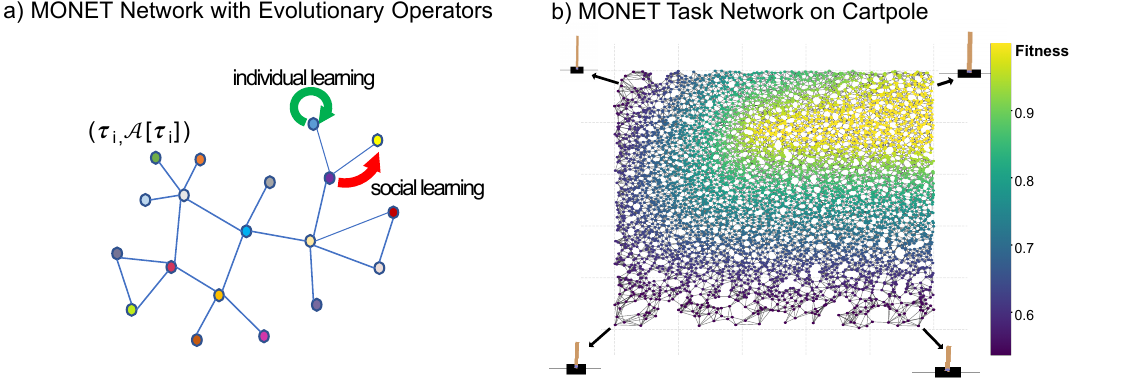
The authors introduce MONET (Multi-Task Optimization over Networks of Tasks), an algorithm that models the task space as a graph: nodes are tasks and edges connect tasks with similar parameters. This representation remains tractable in high-dimensional task spaces and makes topology a first-class structural element of the search. MONET combines social learning — candidates generated by crossover from neighbouring nodes — with individual learning, which improves a node’s own solution by mutation. The separation is inspired by cultural evolution, where individual innovation and the social spread of knowledge together drive adaptation.
Findings
MONET was evaluated on four domains: archery, arm, and cartpole with 5,000 tasks each, and hexapod with 2,000 tasks. Across all four domains, MONET matches or exceeds the performance of the established MAP-Elites variants Multi-Task MAP-Elites (MT-ME) and Parametric-Task MAP-Elites (PT-ME). A systematic hyperparameter study covering neighbourhood type, neighbourhood size, and the balance between social and individual learning further shows that a single configuration generalises robustly across all domains. The results provide evidence that task-space topology is a valuable and underexploited source of information for multi-task optimization at scale.
Citation: Hatzky, J., Bartz-Beielstein, T., Eiben, A. E., Yaman, A. (2026). Multi-Task Optimization over Networks of Tasks. arXiv:2604.21991.