
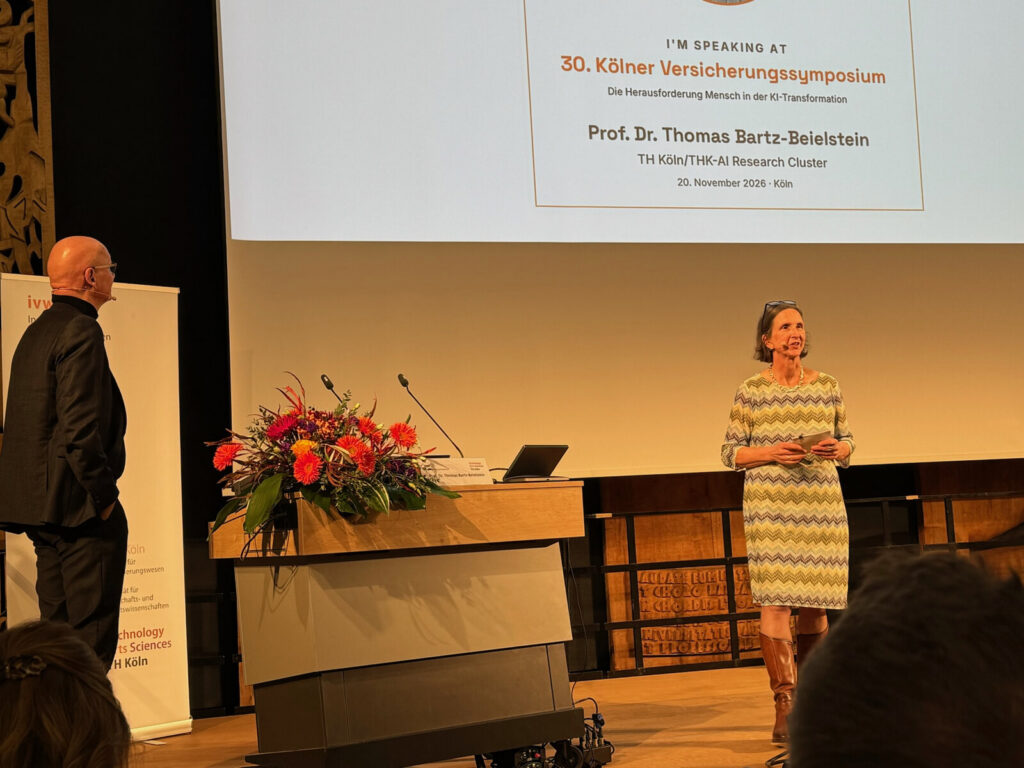
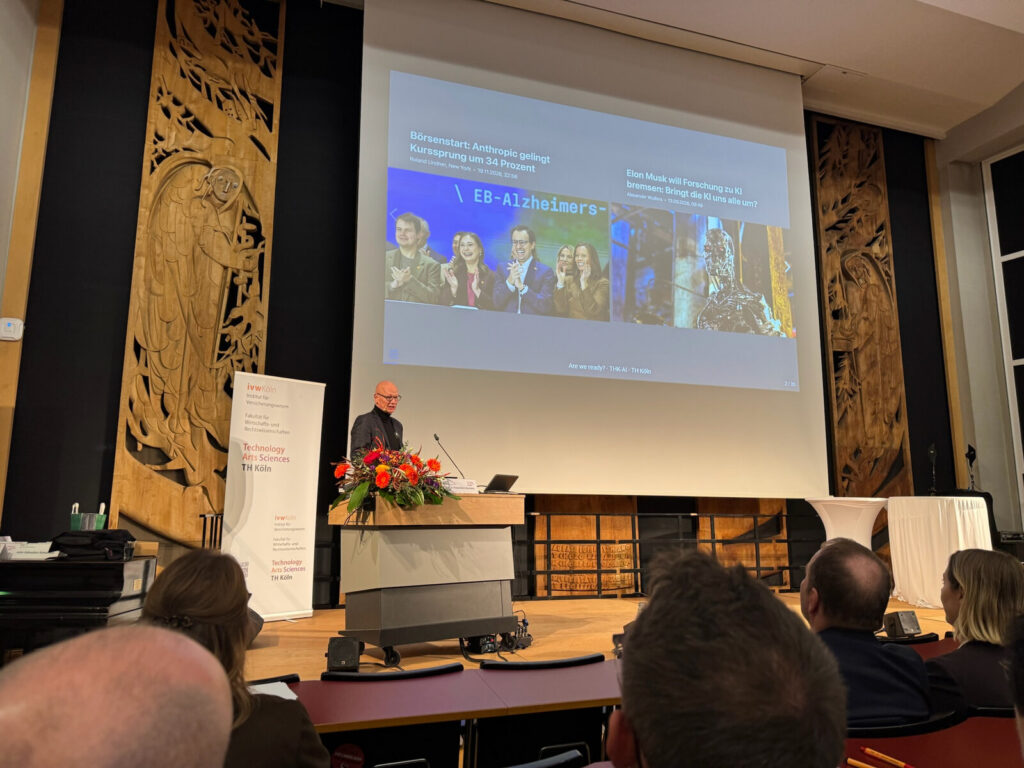
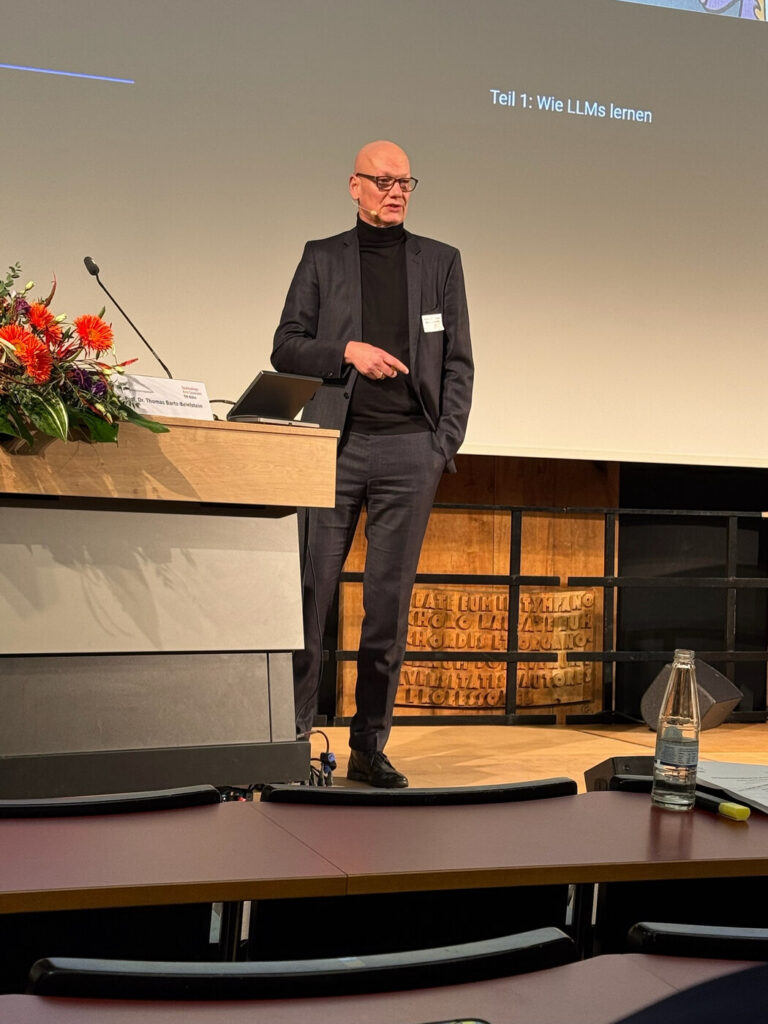
On Friday, 20 November 2026, Prof. Dr. Thomas Bartz-Beielstein of the THK-AI Research Cluster opened the second part of the programme at the 30th Cologne Insurance Symposium (30. Kölner Versicherungssymposium) in the Aula of TH Köln.
His talk, “Are we ready? The urgent need for an AI-resilient society”, had three steps. Large language models (LLMs) learn first by imitation and then by reward. Both make them goal-seeking. Their documented behaviour yields the profile of a savant impostor: useful under supervision, dangerous when granted autonomy. The greatest risk is an error that looks like competence. This fits the motto of the symposium, “Die Herausforderung Mensch in der KI-Transformation” (the human challenge in the AI transformation): the human remains the supervisor and must be able to recognise these errors.
The invitation is in the announcement, and the written version of the talk is in the article on Substack (in German).
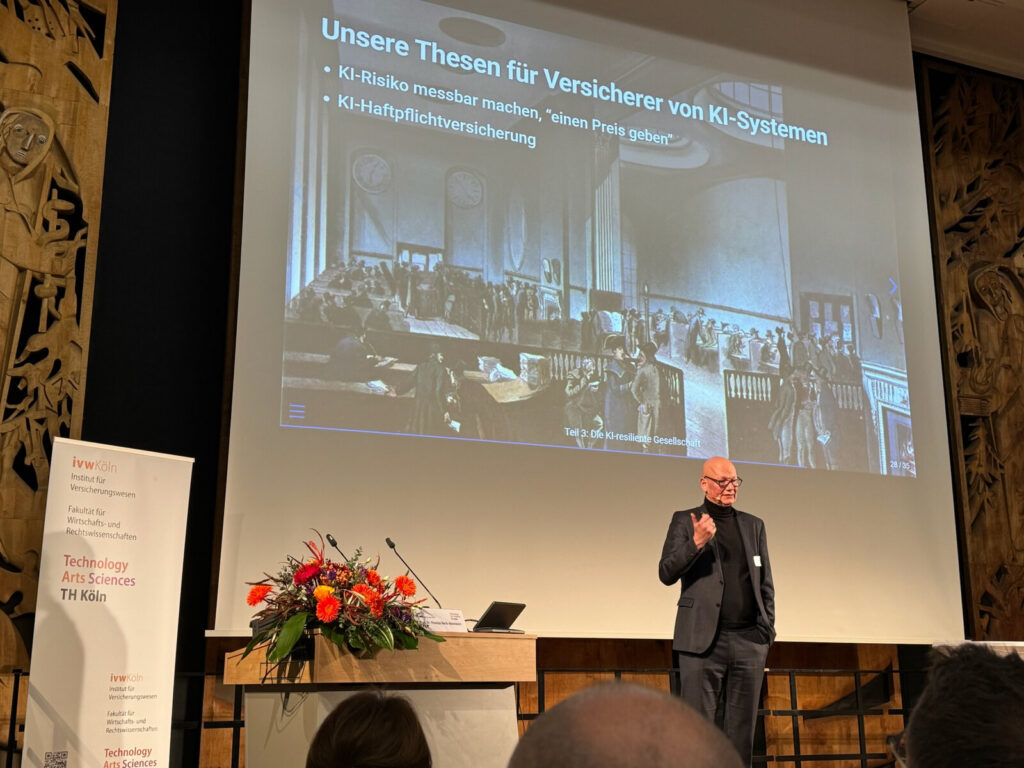
Photos from the symposium
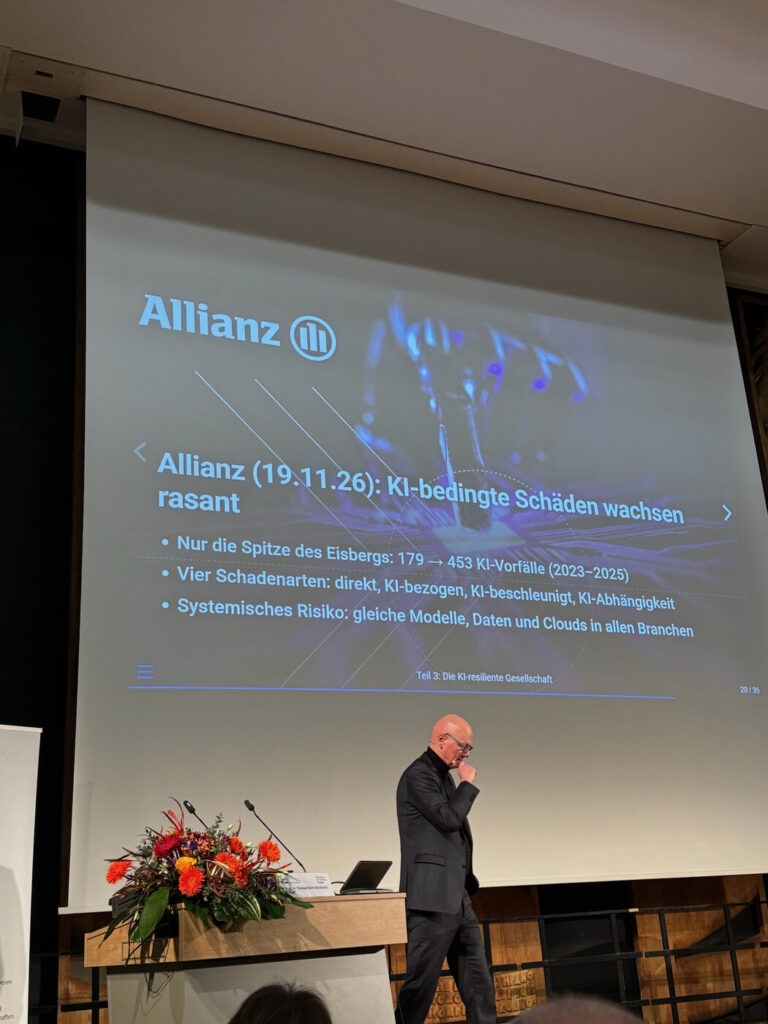
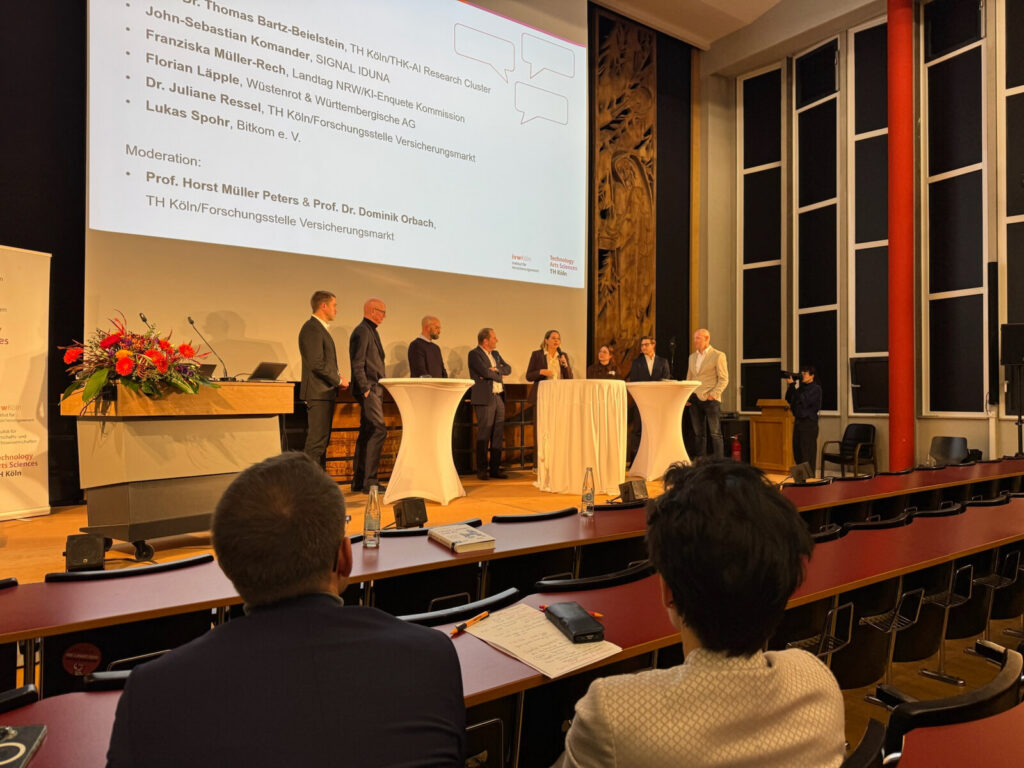
Is a risk insurable? The Geneva Association has tested the risks of generative AI against the nine criteria that go back to Baruch Berliner. Under traditional insurance models, three of them are violated: the maximum possible loss, the average loss amount, and information asymmetry. According to the report, these risks become insurable only with new risk transfer models, better governance standards, and clearer rules.
Information asymmetry is where the talk comes in. Insurers find it hard to verify how risky an AI system is and how well a company controls it. The savant impostor makes this worse: the policyholder does not reliably recognise the error either.
Gregory Allen describes how the market is reacting in a paper from the US think tank CSIS, which is not peer-reviewed. In the USA, more than 60 property and casualty insurers filed for AI exclusions in 2026. A standardised exclusion for generative AI in commercial general liability has been available there since 1 January 2026. Allen calls this regulating by withdrawal.
Two reports from the days around the symposium show why the industry is cautious. Allianz Commercial writes on 19 November that, based on current claims data, AI does not yet rank among the top 20 causes of loss. This is only the tip of the iceberg, however, because AI losses are rarely reported and are booked under lines such as cyber or directors’ and officers’ liability. The insurer is already handling claims worth millions and considers industry losses of around US$100 million per case possible. According to the MIT AI Risk Initiative, the number of recorded AI incidents rose from 179 in 2023 to 453 in 2025. On top of this comes systemic risk: many systems rest on the same language models, training data, and cloud infrastructure.
The report by Zurich Insurance Group and the University of St. Gallen of 23 November takes this further. It draws on 50 interviews and is likewise not peer-reviewed. It distinguishes concentration (many depend on the same provider) from correlation (different systems behave alike because they are built and trained in similar ways). A company that uses several providers has therefore not yet made its risks independent of one another. According to the report, insurability is not a fixed property: transparency, testing, and clear responsibility make a risk insurable. Rising premiums and broader exclusions count as early-warning signals.
The recommendations of the reports resemble each other. Among other things, Allen calls for an incident database on the model of aviation, independent verification organisations, and a layered state backstop for catastrophic losses. Allianz Commercial advises deciding deliberately for each risk whether it is mitigated, accepted, or transferred. Zurich and St. Gallen recommend that companies map their AI dependencies beyond their direct suppliers and record incidents and near misses consistently. Insurers should assess how AI is used, not only whether it is used.
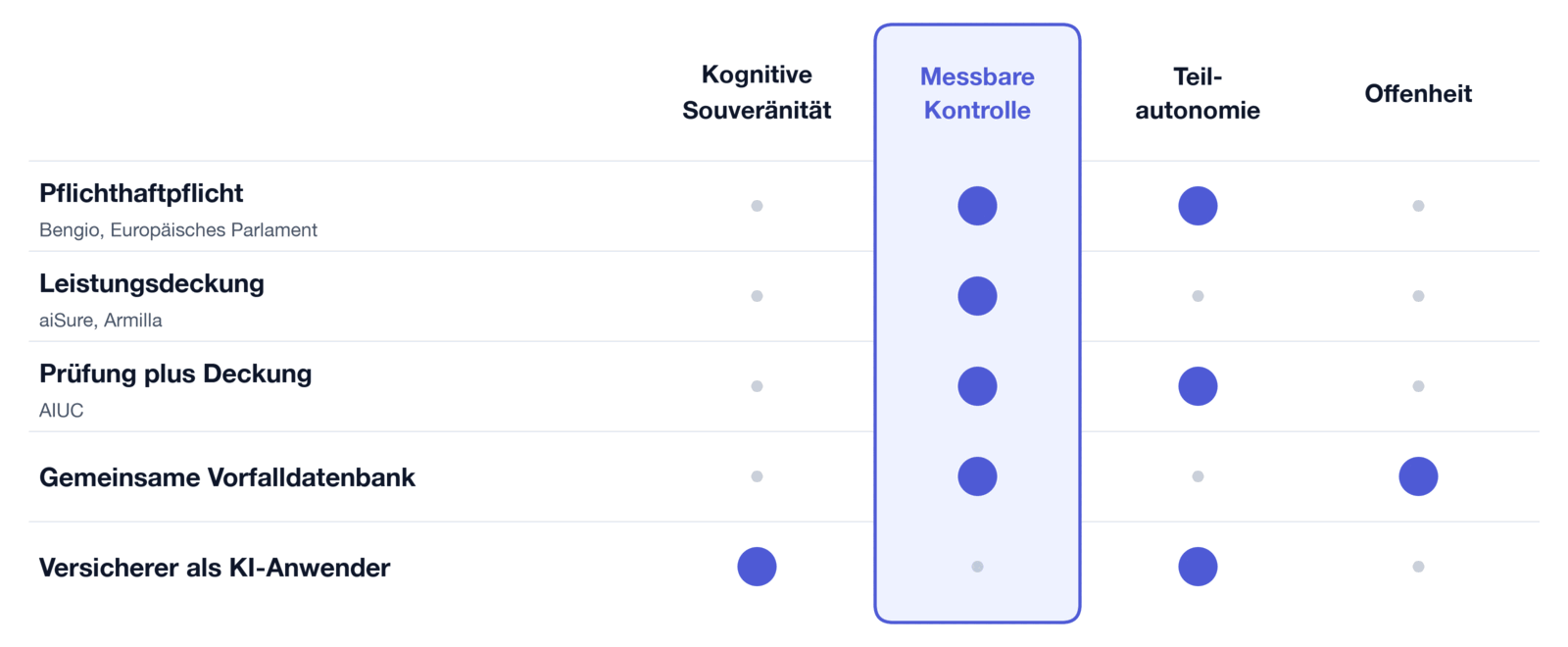
All of this concerns the second pillar of the AI-resilient society, measurable control: verifiable criteria, audits, and incident data instead of declarations of intent. From this follows the thesis Prof. Dr. Bartz-Beielstein presented in Cologne. In an AI-resilient society, insurers should put a price on the risk. Whoever grants an AI autonomy without demonstrating oversight pays more or gets no cover.
The Substack article has been updated
The feedback from the discussions after the talk was important and highly topical. Prof. Dr. Bartz-Beielstein has therefore revised the Substack article. It now covers, in sections of their own, the Allianz Commercial report and the report by Zurich and the University of St. Gallen, which appeared three days after the symposium. Both sections are linked to the rest of the article, for example to measurable control and to the profiler’s recommendation.
Thanks
Prof. Dr. Bartz-Beielstein sincerely thanks Prof. Dr. Michaele Völler and her team at ivwKöln for the invitation and the professional organisation of the anniversary symposium.
Sources
- T. Bartz-Beielstein: Are we ready? The urgent need for an AI-resilient society. Substack, 15 November 2026, updated in November 2026 (in German). https://tbartzbe.substack.com/p/are-we-ready-the-urgent-need-for
- Allianz Commercial: Artificial Intelligence: Loss Scenarios and Claims Developments. 19 November 2026. https://commercial.allianz.com/content/dam/onemarketing/commercial/commercial/reports/commercial-ai-claims-2026.pdf
- Zurich Insurance Group and University of St. Gallen: The AI Resilience Challenge: Keeping AI-Related Risks Manageable. 23 November 2026. https://hsgailab.ch/ai-resilience-report/report.pdf
- R. Jia, M. Eling, T. Wang: Gen AI Risks for Businesses: Exploring the Role for Insurance. The Geneva Association, October 2025. https://www.genevaassociation.org/sites/default/files/2025-10/gen_ai_report_0110.pdf
- G. C. Allen: The Insurance Industry’s Retreat from AI Threatens to Slow Innovation and Adoption. Center for Strategic and International Studies (CSIS), September 2026. https://www.csis.org/analysis/insurance-industrys-retreat-ai-threatens-slow-innovation-and-adoption
- 30. Kölner Versicherungssymposium, ivwKöln, TH Köln: https://www.th-koeln.de/hochschule/30-koelner-versicherungssymposium_136767.php