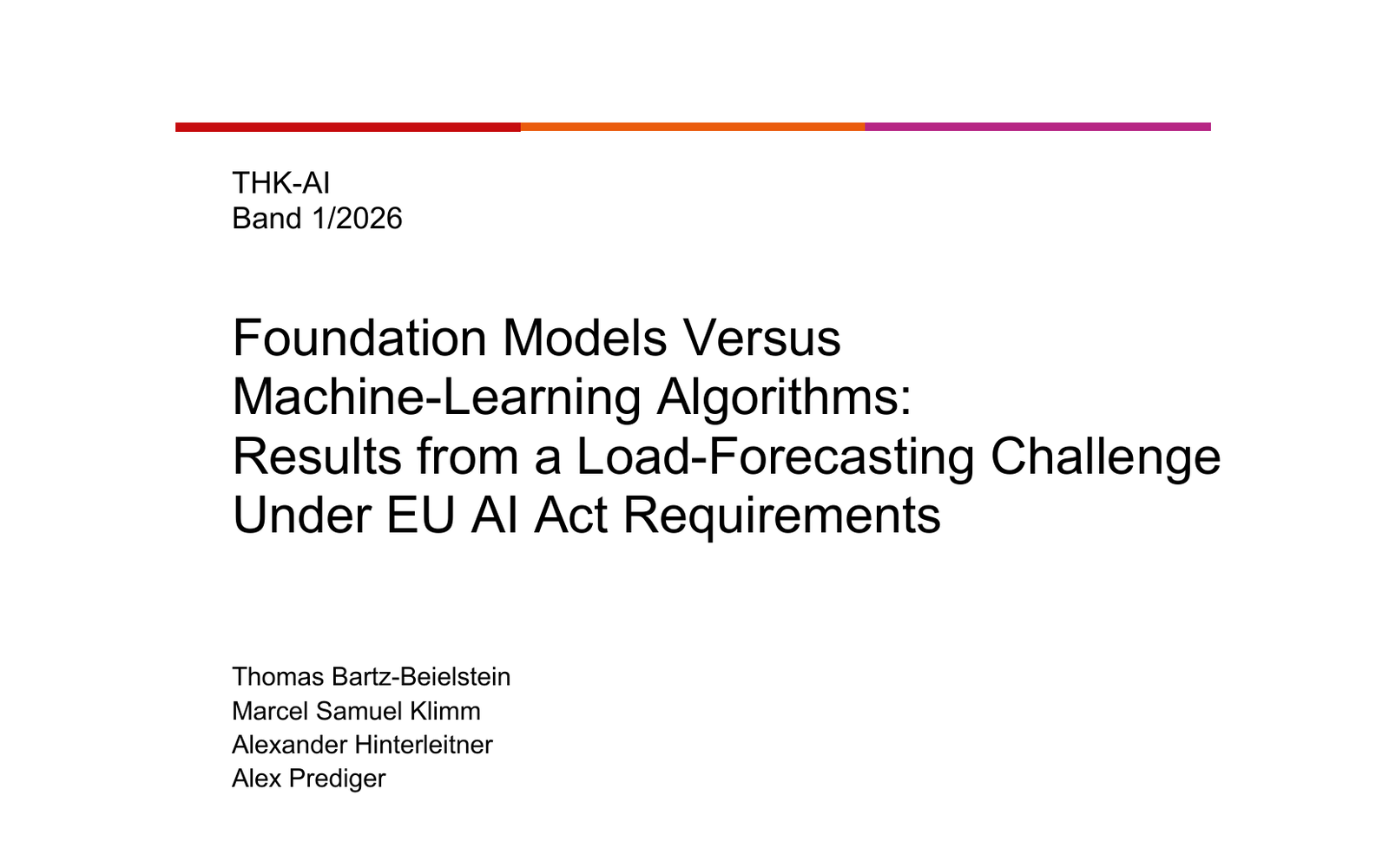
On 13 October 2026, Cologne Open Science, the open access repository of TH Köln, released the paper “Foundation Models Versus Machine-Learning Algorithms: Results from a Load-Forecasting Challenge Under EU AI Act Requirements” by Marcel Samuel Klimm, Alexander Hinterleitner, Alex Prediger and Thomas Bartz-Beielstein. This is volume 1/2026 of THK-AI, the new publication series of the thk-ai research cluster, and therefore the first publication in that series. More volumes will follow.
What the first volume is about
Short-term load forecasting predicts the electricity demand of the next hours to days. Under the EU AI Act, we argue, it is no longer a pure accuracy problem: determinism, fail-safe behaviour, a minimal attack surface and full auditability become software engineering requirements. The paper reports a 41-day live challenge held at TH Köln from 10 June to 20 July 2026, in which eleven student teams and eight reference models operated by the organisers forecast the 24 hourly values of the aggregated German transmission-grid load one day ahead.
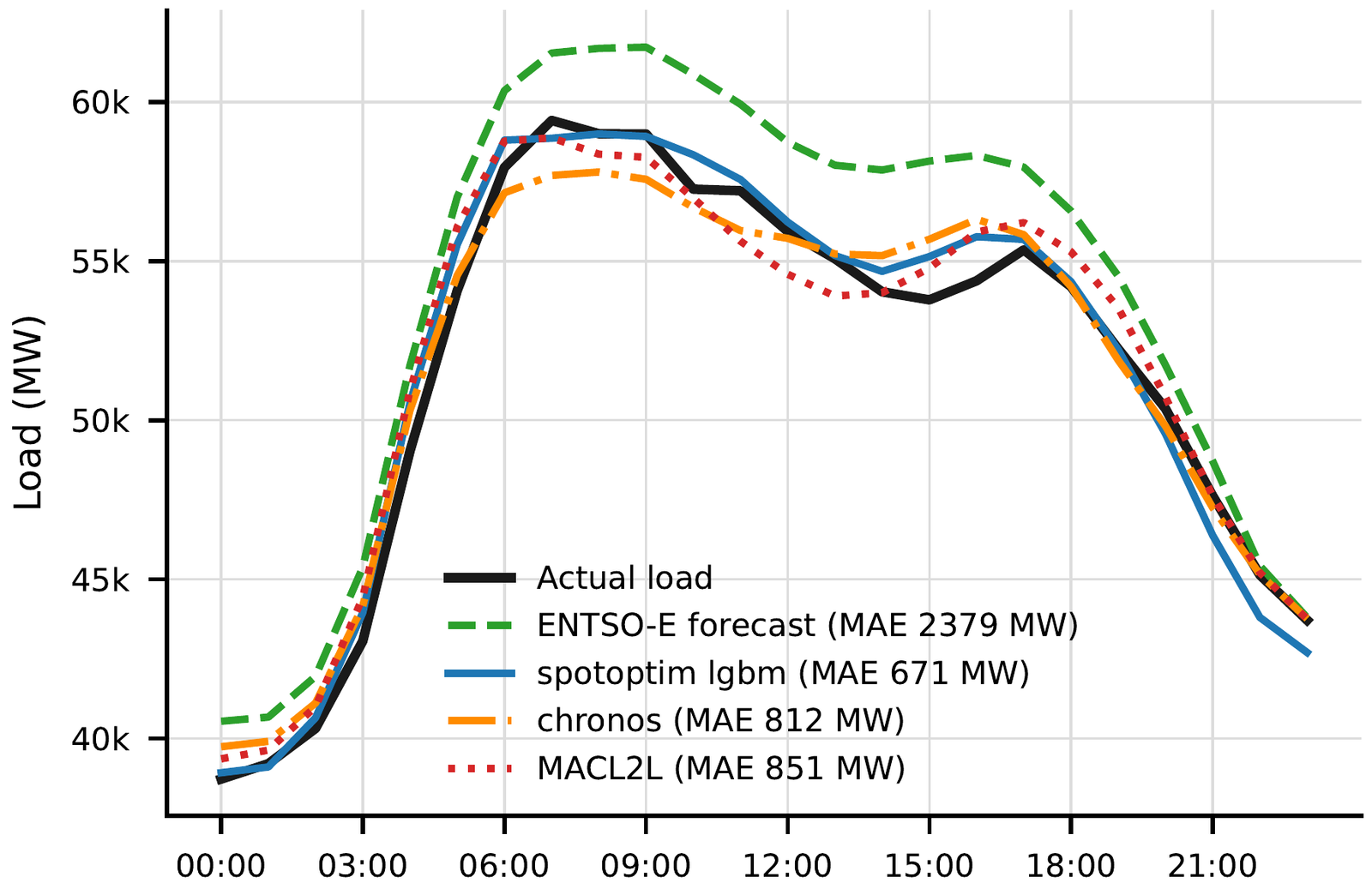
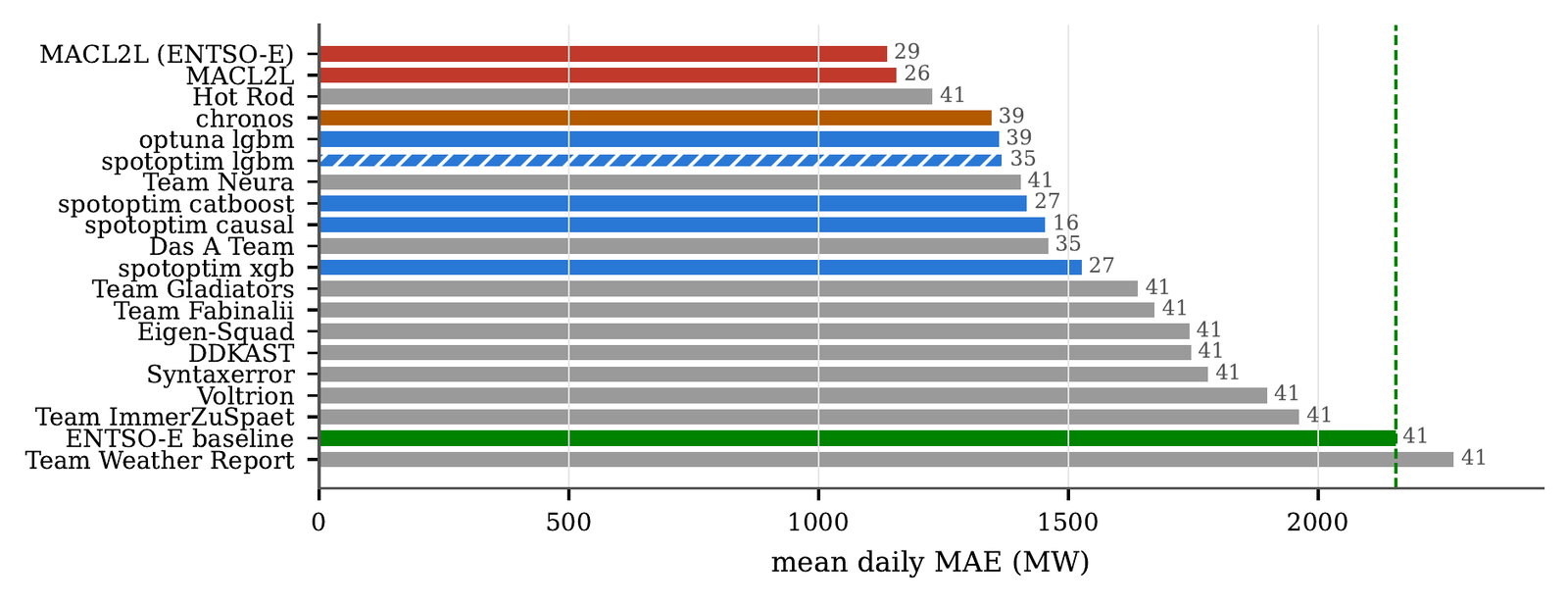
Three findings stand out. First, the rule-compliant reference pipeline, a deterministic recursive LightGBM forecaster built on spotforecast2-safe and tuned by spotoptim, reduced the mean absolute error of the official ENTSO-E day-ahead forecast by 34.7% on the jointly evaluated days. Compliance and accuracy were not in conflict. Second, ten of the eleven student teams were more accurate than ENTSO-E. Third, transparent local in-context models (MACL2L) led the leaderboard and were at least competitive with the pretrained foundation model Chronos-2, which has more than 100 million parameters. All differences were tested with Holm-corrected paired tests, and the rankings are stable across four accuracy metrics.
A new series with a long history
THK-AI is not a start from zero. It continues the series CIplus, which the research focus Computational Intelligence plus ran on Cologne Open Science from 2012 onwards. As of 13 October 2026, the CIplus series lists 55 publications: technical reports, working papers, preprints, journal and conference articles by members and guests of the group, among them several master theses. The series page now states that CIplus has been discontinued and is continued as THK-AI.
The THK-AI series collects and publishes preprints, research papers, research reports, dissertations and final theses from the thk-ai research cluster. Its two focus areas are AI methods for autonomous and safety-critical systems, in particular critical infrastructure, and socially interactive AI agents, socio-empathic dialogue systems and hybrid avatars. The editorial board consists of Anja Richert, Boris Naujoks, Jörg Luderich, Edwin Kamau, Gernot Heisenberg, Pascal Cerfontaine and Thomas Bartz-Beielstein as managing editor. Everything in the series is open access, citable with a DOI and a URN, and archived by the university library.
What comes next
Further volumes are in preparation, and I will announce each of them here.
Publications
-
- T. Bartz-Beielstein, M. S. Klimm, A. Hinterleitner, A. Prediger: Foundation Models Versus Machine-Learning Algorithms: Results from a Load-Forecasting Challenge Under EU AI Act Requirements. THK-AI 1/2026, Cologne Open Science, TH Köln, 2026. https://doi.org/10.57684/COS-1513