Prof. Dr. Mohieddine Jelali, who leads the Cologne Laboratory of Artificial Intelligence and Smart Automation (CAISA) at the Institute of Product Development and Engineering Design (IPK) at TH Köln, investigates how deep learning can support automated fruit harvesting. His latest publication, a systematic review in Artificial Intelligence Review, was written together with Fabian Gerz, Orhan-Timo Altan and Dr. Loui Al-Shrouf.
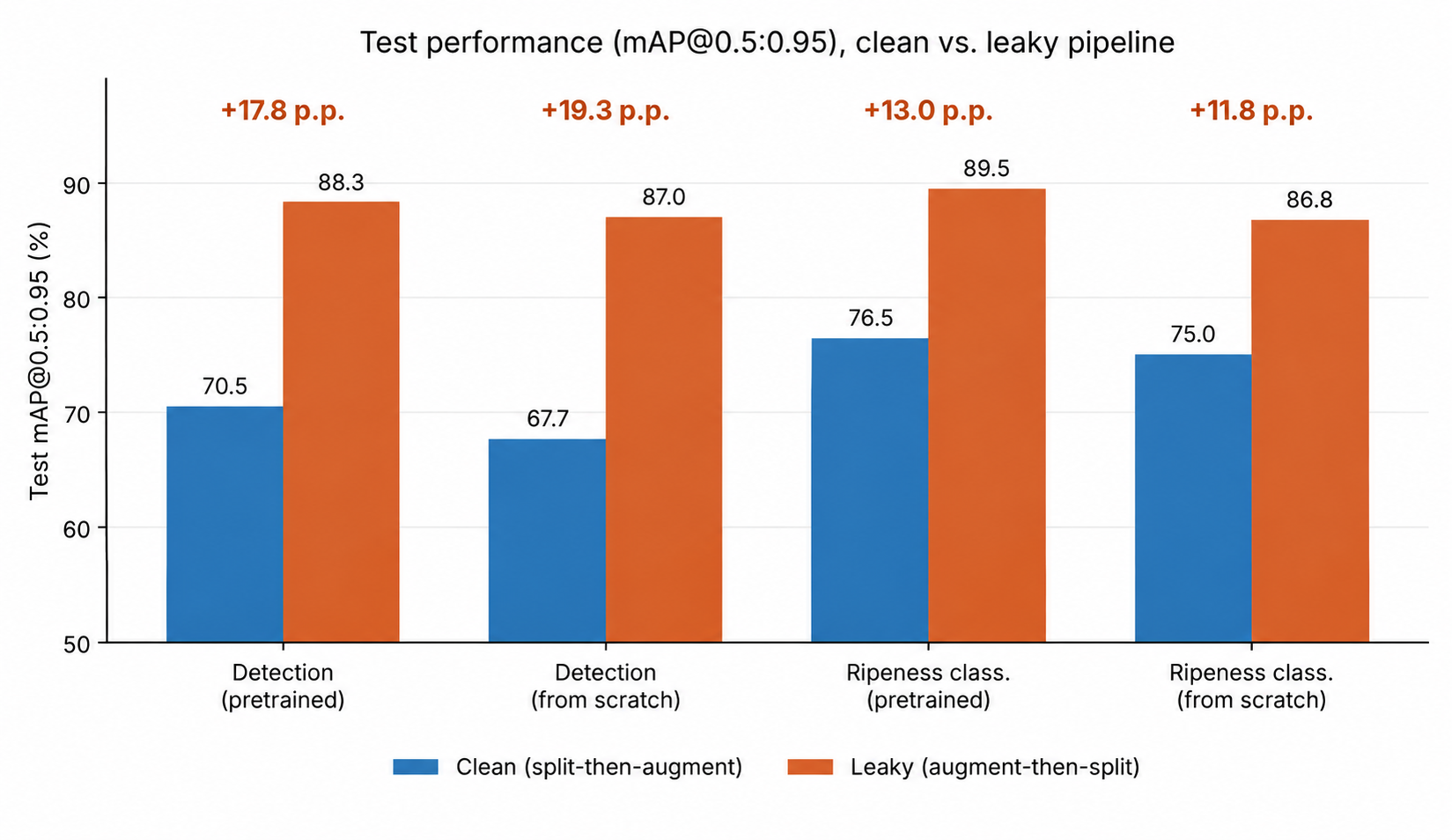
Harvesting robots need to detect strawberries, judge their ripeness and locate the picking point. The review analyses 60 studies from 2023 to March 2026 that use YOLO models for these tasks. It compares datasets, augmentation, architectures and evaluation protocols. Lightweight modifications reduce parameters and computation by about 17% with no real loss of accuracy, whereas accuracy-oriented modifications gain about 1% mAP at the cost of speed. In 21 of the 60 studies, images were augmented before the train/test split. A controlled experiment with YOLOv8 on the StrawDI_Db1 dataset shows that this can inflate test performance by 11.8 to 19.3 percentage points. The experiment shows the size of the effect, but it does not re-evaluate the individual studies.
The work is motivated by the need for reliable vision components in strawberry harvesting robots and was partly funded within the project Erntbot by the German Federal Ministry for Economic Affairs and Climate Action. The review therefore also derives recommendations for fair benchmarks, open code and datasets, and integrated systems that combine detection, ripeness estimation and picking point localization. The code of the experiment is publicly available on Zenodo.
Link to publication: https://doi.org/10.1007/s10462-026-11747-8